
CATS 2015, another step towards active participation of children and young people
July 2015
The third edition of CATS – Children as Actors for Transforming Society – is soon upon us. This year the Caux Palace is welcoming 315 participants, including 168 under-25s, for a programme more participatory than ever, full of space for sharing experiences of children’s participation and debating issues of children’s rights.
One of our five influential keynote speakers is a young man called Kesz Valdez. Three years ago, Kesz won the International Children’s Peace Prize for his remarkable work in the Cavite slums in The Philippines. He has subsequently founded a youth-led organisation called Championing Community Children C3, which strives to improve the day-to-day realities of street children. Kesz is also part of The KidsRights Youngsters, a youth-led advocacy and awareness-raising platform of the International Children’s Peace Prize organisation, that aims to realise children’s rights around the globe.
The other Keynote Speakers are no less inspiring. We will welcome Kirsten Sandberg, Chair of the UN Committee on the Rights of the Child; Judith Diers, Child Adolescents Development & Participation at Unicef; Julie Ward, strong advocate for children’s rights at the European Parliament; Nkem Orakwue, Founder/Co-ordinator of the Nigerian Children’s Parliament & Executive Director of TV programmes; and Dimitri Avramopoulos, European Commissioner responsible to EAC for Migration, Home Affairs and Citizenship.
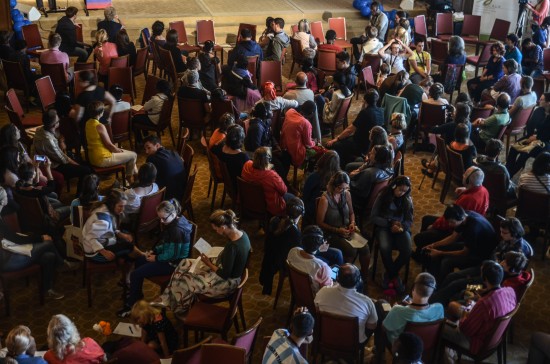
Children, young people and adults working together at CATS 2014.
Towards creating the partnership between children and adults
Together with the participants, our Keynote Speakers will explore how partnership and collaboration between children, young people and adults are crucial to enabling children’s participation in society.
To ensure that all can participate equally and meaningfully, we have ditched the traditional plenary format! Intead, each morning the 300 participants will come together to share experiences, debate ideas, and increase their understanding about how to build an effective partnership between generations.
Some of the activities we have scheduled include the ‘Human Library’. Participants will have the chance to become “human books” and tell their stories of children’s participation. We will also develop a global children’s rights timeline and debate the moral dilemmas faced by children and young people. The evening programme will also be interactive, fun and informative. Participants will have the opportunity to learn about the work on children’s rights that the various organisations do in their own countries; take part in a Talent show; and discuss children’s participation through a selection of films on children’s rights issues.
There will also be a series of participatory workshops open to all ages. These workshops will equip participants with new skills and competences to enable them to work more effectively towards realising children’s right to participate, once back home. They will even have the chance to feed into a UN document, the General Comment on Adolescents, commissioned by the UN Committee on the Rights of the Child. Child rapporteurs from a number of different workshops will help to feed back into a project with the European Parliament for making children’s voices heard on policy issues.
Child participation in action at CATS… and after CATS?
With 315 participants, 26 delegations of children and 43 nationalities, this year’s CATS offers greater potential than ever for impacting on children’s participation worldwide.
Children, young people and adults from the previous editions have told us how they felt inspired by CATS and were determined to take home what they had learned and improve the extent and quality of child participation in their own communities. They confirmed that they would disseminate its core messages: children have the right to be listened to and taken seriously. Society as a whole must aspire to respect this right and put in place the laws and policies necessary to ensure that children and young people have the concrete means to realise it.
To read the CATS Newsletters and learn more about the programme, click here.