
Realising children’s right to education leads to better gender equality
March 2015
Our Paths to School Success project in Sindh province in Pakistan is having a series of positive impacts on gender equality and gender relations in the communities where we are working.
It has now been two years that we are working in partnership with the Teachers Resource Centre on an early childhood development project in eight disaster affected communities in the Sindh province, where gender equality is traditionally an issue.
Traditional sociocultural norms of segregation between the sexes
According to the traditional socio cultural norms of rural communities in Sindh, it is against their belief system as well as communal practices to hold joint gatherings with members from both sexes present. Cultural norms mean that men are women are more comfortable to sit separately at social gatherings.
Our local partner the Teachers Resource Centre has tried to organise joint meetings for Community Advisory Board members, but this is a huge undertaking and will take time.
Nonetheless the Community Advisory Board (CAB) members have decided to focus on girls’ education, since the retention of girls in education is of significant concern: girls are traditionally not allowed to attend school when they are physically mature. Instead, they are required to help with housework and are often married whilst still very young.
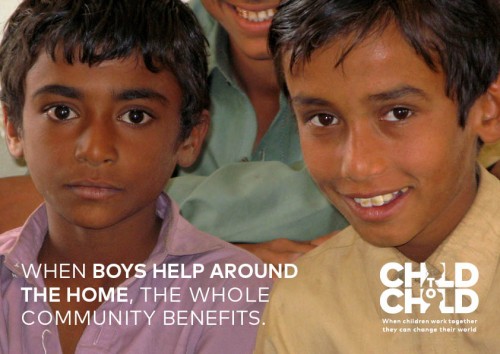
Boys more involved in domestic chores
In one of the project communities, a teacher told us: “Young Facilitator Irfan used to order his sisters around for every petty task in the house. But his aunt told us that one day she saw Irfan going to school and asked whether he ate something or not. He said he did. He explained that he ate chapatti (bread) and chutni. The aunt asked who made the chutni to which he proudly responded that he made it himself! The aunt was quite shocked. He went on to say that he has been given two hands by God so he put them to use, took some tomatoes, salt, green chillies and onion and ground them on the grinding stone and readied his own meal.”
The teacher happily commented that, “it is a great change; thank God the boys now are taking responsibility for household tasks too.”
To help us challenge gender stereotypes and reach more girls and boys in Pakistan with our award winning work, please donate here.